
How Are Fashion Brands Using AI in Design?
See how Nike, H&M, Zalando and Collina Strada use AI in fashion design, from trend spotting to digital samples, plus simple steps to get started.
Ask ten designers how AI fits into their work and you will get ten different answers. Some use it every morning to build mood boards. Some only trust it for product photos. A few have let it help shape a whole runway collection.
This guide looks at what real fashion brands are doing with AI in design, what results they have shared, and where the technology still falls short. If you run a fashion label or an online store, you will also find simple steps to start without losing your brand's style.
The Quick Answer
Fashion brands mainly use AI in design to:
- Spot trends early by scanning social media images
- Generate concept ideas and mood boards in minutes
- Build on their own archive to create new looks in their signature style
- Create prints, patterns and colorways faster
- Replace many physical samples with 3D digital samples
- Produce on-model visuals without a full photoshoot
In every one of these, the designer still makes the final call. AI speeds up the work, and people decide what is good.
Why Are Fashion Brands Turning to AI Now?
The shift is happening fast, and the money behind it is serious.
- McKinsey estimates generative AI could add $150 billion to $275 billion to operating profits in apparel, fashion and luxury within three to five years, and up to a quarter of that value could come from design and product development.
- In the 2026 State of Fashion report, more than 35% of executives said they already use generative AI for tasks like image creation, copywriting and customer service.
- Leaders named scaling AI as the single biggest opportunity for the industry in 2026.
There is also a warning in the data. Up to 90% of AI projects never grow past the pilot stage, mostly because the data and tech underneath them are too weak. The brands in this guide stand out because they tied AI to a clear job in their design process.
6 Ways Fashion Brands Are Using AI in Design
1. Spotting Trends Before They Peak
Trend forecasting used to rely on runway shows, magazines and gut feeling. Now brands add data from what real people wear and post.
- Platforms like Heuritech scan millions of social media images and detect around 2,000 fashion details, from prints and colors to fabrics and shapes.
- Heuritech says its model can predict trends up to 24 months ahead with 90% accuracy. That is the company's own claim, so treat it as a guide and not a promise.
- Brands such as Louis Vuitton, Dior and Moncler have used this kind of data to inform their decisions.
The expert view: even forecasters say data needs human judgment. Francesca Muston of WGSN has said AI can supercharge forecasting, but teams must add real rigor and process, and experts must check the output so it does not lead to wrong conclusions.
Why it matters for design: designers can see which colors or silhouettes are rising in each market. They can then balance a collection before any fabric is ordered.
2. Faster Mood Boards and Concept Ideas
This is where most designers first meet AI. Instead of spending days collecting images, they can explore hundreds of visual directions in an afternoon.
Real example: Nike A.I.R. Nike used AI to create concept shoes for 13 of its top athletes.
- The team first interviewed each athlete about their style, personality and life story. AI then summed up those answers and produced hundreds of images for each athlete.
- Designers picked three bold concepts per athlete. At times they had to push back against the AI's habit of making every idea look soft and fluid, so each shoe stayed unique.
- Nike has also said it is building its own AI model in house, alongside the public tools it uses.
Nike's design team described AI as “a sharper, more intelligent pencil”, with the designer still in control.
Key takeaway: AI is great at giving you many options quickly. The designer's eye is what turns one of those options into a real product.
3. Building New Looks From a Brand's Own Archive
Some brands train or guide AI with their own past work, so the results look like them rather than like everyone else.
- For Spring/Summer 2024, Collina Strada founder Hillary Taymour and her team spent weeks feeding past Collina Strada looks into Midjourney, guiding it with text prompts and refining the results into a collection.
- She started from her own brand imagery on purpose, to avoid copyright problems and make sure the collection felt like hers.
- She also admitted the tool took about a week to get comfortable with.
Why this approach works: your archive holds your brand's DNA. Using it as the starting point keeps AI output on brand and reduces legal risk.
4. Prints, Patterns and Colorways
Prints are one of the easiest places to start. You can test many versions of a pattern or color story before a single yard of fabric is printed. Taymour's own advice is that AI works well for print and pattern ideas, but it should not take over the whole design process.
- Turning a hand sketch into several print directions
- Testing one print in many colorways
- Checking how a pattern looks at different scales on a garment
- Creating seasonal variations of a signature motif
5. 3D Design and Digital Samples
Physical samples cost money, create waste and take weeks to ship back and forth. 3D design tools, which increasingly include AI features, let teams review a garment on screen first.
- Tommy Hilfiger set a goal to remove physical sketches and samples from much of its design process, so most products exist only as 3D designs until they are made.
- The brand said its men's dress shirts for Fall 2020 would be fully 3D designed with no physical samples, and that its Spring 2022 apparel collections would be designed fully in 3D.
- Its CEO said the approach could speed up time to market and even replace traditional product photography.
Benefits brands report: fewer wasted samples, faster approvals between designers, buyers and factories, and the same 3D file can be reused for showrooms and marketing.
6. AI Models and Virtual Photoshoots
Design is not finished until the customer can see the product. This is where AI is changing the most, and where many mid-sized brands see the fastest return.
- Zalando: about 70% of its editorial campaign images in late 2024 were AI generated. The company says this cut image production time from six to eight weeks down to three or four days, and cut costs by 90%.
- H&M: worked with tech firm Uncut to create digital twins of 30 real models, released in its first campaign in July 2025. The models keep full rights to their digital twins, are paid at rates similar to normal image use, and AI content carries clear watermarks.
- Mango: for its Mango Teen “Sunset Dream” collection, Mango photographed each real garment, trained an AI model to place the garments on a model, then had its art team select and retouch the final images. The campaign ran in 95 markets.
Where smaller brands fit in: you do not need Zalando's budget to work this way. Platforms like Fashion Studios let a small team create an AI model, upload real garments, and set the pose, background and lighting. The result is a studio-quality image or video without booking a shoot. Designers can also see a new style on a model before physical samples arrive, which helps with early approvals and preorder pages.
Traditional Design vs AI-Assisted Design
Across the design process, AI speeds up the heavy lifting while people keep the decisions that need taste and judgment:
- Trend research — Traditional: runway reports, magazines, store visits. With AI: data from millions of social images. Still needs a human: deciding which trends fit the brand.
- Concept and mood boards — Traditional: days of collecting references. With AI: hundreds of ideas in hours. Still needs a human: choosing a clear creative direction.
- Prints and colorways — Traditional: hand drawn or manual digital work. With AI: many versions tested in minutes. Still needs a human: taste, originality, brand fit.
- Sampling — Traditional: several physical samples per style. With AI: 3D digital samples on screen. Still needs a human: fit checks and the final physical sample.
- Product visuals — Traditional: full photoshoot, weeks of planning. With AI: a virtual photoshoot in minutes. Still needs a human: art direction and quality control.
- Approval — Traditional: waiting for samples to ship. With AI: review visuals right away. Still needs a human: the final sign off.
What AI Cannot Do (Yet): Limits and Risks
A helpful guide should tell you the downsides too. Here is what brands have learned.
It Can Make Everything Look the Same
AI learns from existing images, so its ideas can drift toward what already exists. Nike's designers saw this firsthand when they had to correct the AI's lean toward one kind of shape.
Body Image and Representation Concerns
Critics worried that Mango's AI models, with flawless skin and slim figures, could set unrealistic standards for the teenage girls the campaign targeted. If you use AI models, choose diverse body types, ages and skin tones on purpose.
Impact on Creative Jobs
Critics of H&M's digital twins argued the technology could reduce work for photographers, makeup artists and hair stylists over time. The brands handling this best are paying talent fairly and being open about it.
Copyright and Ownership
The law on AI-generated work is still developing. Starting from your own sketches, photos and archive, like Collina Strada did, is the safest route. Always check a tool's commercial rights terms before you sell anything.
Honesty With Customers
Being open builds trust. Mango's product pages disclose when a model image is AI generated, and H&M watermarks its AI content.
How Smaller Fashion Brands Can Start Using AI in Design
You do not need a tech team. Start small and pick one problem.
- Step 1 — Find your biggest time drain. Is it trend research, sampling, or product photos? Start where you lose the most time or money.
- Step 2 — Start with your own material. Use your sketches, past collections and real garment photos as inputs. This keeps results on brand and reduces legal risk.
- Step 3 — Try one tool for one job: an image generator for mood boards and prints, 3D software such as CLO 3D or Browzwear for sampling, and a virtual photoshoot tool such as Fashion Studios for product and campaign visuals.
- Step 4 — Keep a human in every final decision. Every brand in this guide had designers or art teams review, edit and approve the AI output.
- Step 5 — Measure results. Track time saved, samples avoided, and how the new visuals perform on your product pages. Keep what works and drop what does not.
- Step 6 — Be open with your audience. Label AI visuals where it matters and show the people behind your brand.
Final Thoughts
AI is not designing fashion on its own. Nike, Collina Strada, Tommy Hilfiger, H&M, Mango and Zalando all use it the same basic way: people set the vision, and AI helps them move faster, test more ideas and waste less.
For growing brands, the easiest wins are usually faster concepts and faster visuals. If product photography is slowing down your launches, a virtual photoshoot tool like Fashion Studios is a simple place to start. Keep your designers at the center, and let AI take care of the slow parts.
Frequently Asked Questions
Will AI replace fashion designers?
No. In every real case in this guide, designers chose, edited and approved what AI produced. AI changes how designers work, but taste, brand vision and final decisions still come from people.
What AI tools do fashion designers use?
Common types include image generators for mood boards and prints, trend platforms like Heuritech, 3D design software like CLO 3D and Browzwear, and virtual photoshoot platforms like Fashion Studios for on-model images and videos.
How are fashion brands using AI models?
Brands like H&M, Mango and Zalando use AI models or digital twins of real models for campaigns, social media and product pages. This cuts shoot costs and time, especially when brands need content for many markets quickly.
Is AI trend forecasting accurate?
It can be very useful, but no forecast is perfect. Treat AI forecasts as one strong input, and combine them with your sales data and your team's knowledge of your customers.
Can I sell clothes designed with AI?
Yes, many brands already do. To stay safe, start from your own designs and archive, avoid prompting for other brands' work, and read each tool's commercial rights terms. For specific legal questions, speak with an IP lawyer in your country.
Should brands tell customers when images are AI generated?
It is a good idea. Clear labels, like the watermarks H&M uses, help build trust with shoppers.
Is AI design only for big brands?
Not anymore. Many AI tools offer free trials or low monthly plans, so small labels and ecommerce stores can test them without a big budget.
Other Blogs
View All
How to Create AI Fashion Models
Learn how to create AI fashion models step by step, from product photos and model setup to prompts, quality checks, legal disclosure, and choosing the right AI fashion tool.
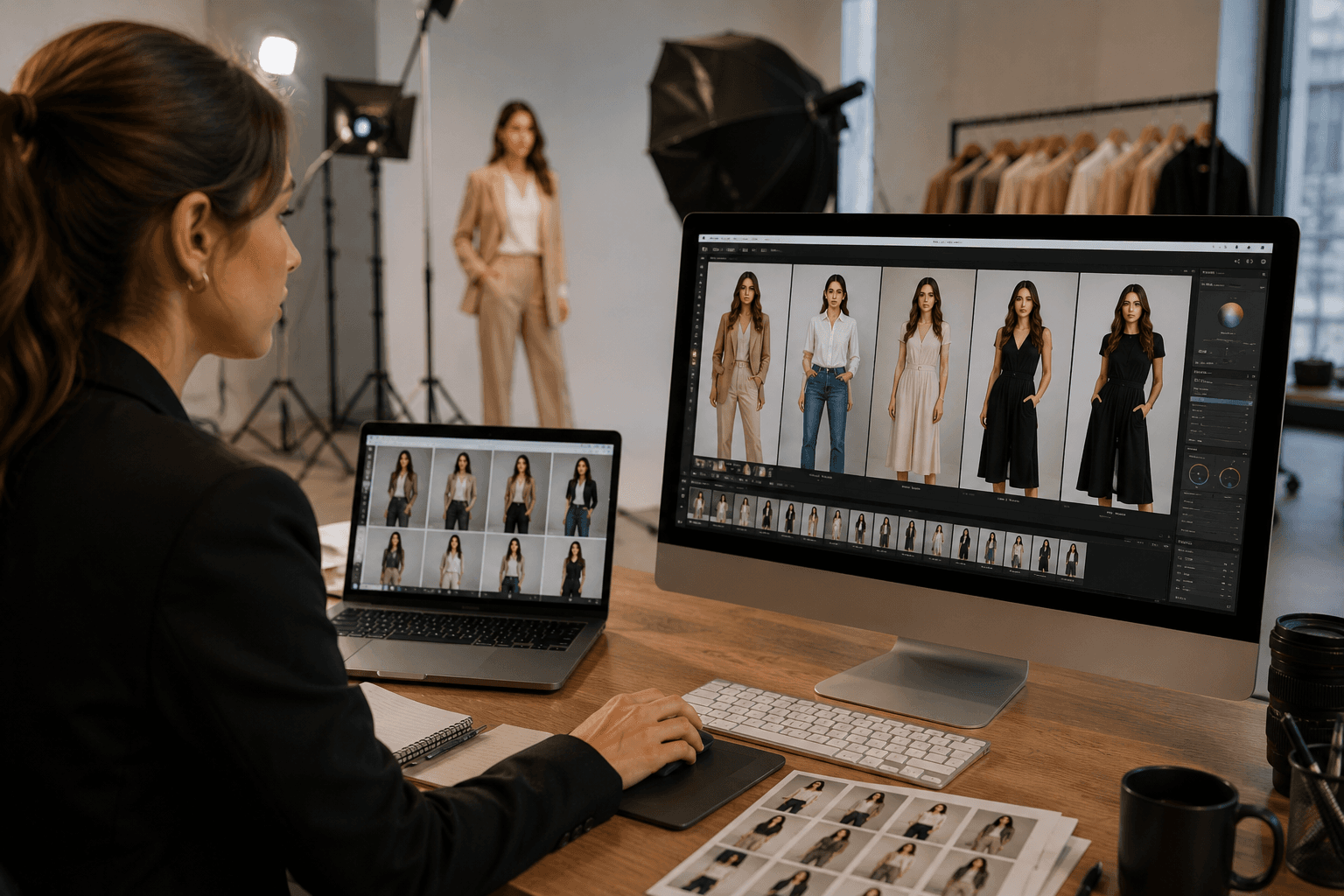
How AI is Transforming Fashion Production & Photoshoots
The fashion industry is evolving faster than ever before. Traditional fashion production workflows that once required photographers, studios, models, makeup artists, stylists, and complex logistics are now being transformed by artificial intelligence.
The Future of Virtual Try-On: AI Models, Clothing & Accessories
The fashion industry is rapidly moving toward digital experiences powered by artificial intelligence. One of the biggest innovations transforming online fashion shopping and production is AI virtual try-on technology.